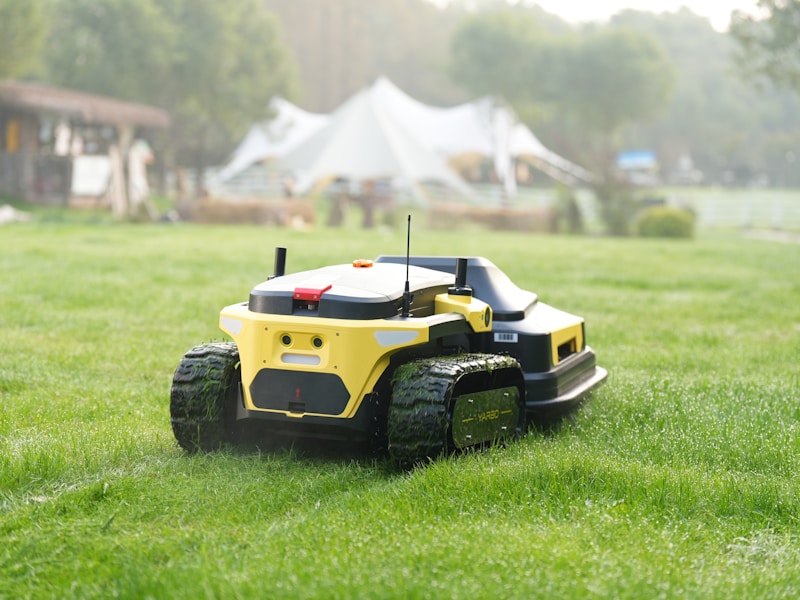
Mowing the lawn is one of those Saturday morning chores that feels unavoidable — until it is not.
Automatic lawn mower robots have been around for years, but 2026 is genuinely different. The technology has crossed a threshold where these machines are no longer expensive novelties for early adopters. They are practical, increasingly affordable, and — in the AI-powered versions — genuinely impressive pieces of autonomous technology.
But here is what most buyers discover too late: there are two fundamentally different types of automatic lawn mower robot on the market, and choosing the wrong one for your yard is an expensive mistake.
Regular automatic lawn mower robots. And AI automatic lawn mower robots.
They both cut grass. Everything else about them is different.
What is a Regular Automatic Lawn Mower Robot?
A regular automatic lawn mower robot is a battery-powered cutting machine that moves around your yard autonomously and trims the grass. The key word is "around" — how it navigates is what separates the old technology from the new.
Traditional automatic lawn mower robots rely on a perimeter wire buried around the boundary of your lawn. This wire sends a signal that the robot follows to understand where your lawn ends. Inside the wire, the robot moves in random or systematic patterns, cutting as it goes.
This technology works. Husqvarna's Automower series has been running on this principle for over two decades and has millions of satisfied users globally. The limitation is the wire itself — you need to bury it around your entire lawn, which is a setup process that takes several hours and is genuinely inconvenient if you want to change your lawn layout later.
The other limitation is intelligence. A wire-guided robot knows where your lawn ends. It does not know where the obstacles are, where the grass is thicker, which areas it has already cut, or how to handle complex shapes efficiently.
What is an AI Automatic Lawn Mower Robot?
Today's robotic mowers offer a wide range of technologies, from wire-free RTK navigation and AI Vision to LiDAR obstacle detection and smart app control.
An AI automatic lawn mower robot uses a combination of technologies to understand and navigate your yard without any buried wire:
RTK GPS (Real Time Kinematic GPS) — centimetre-level precision positioning that tells the robot exactly where it is in your yard at all times. Much more accurate than regular GPS.
LiDAR — laser scanning technology that builds a 3D map of your yard in real time, detecting obstacles, slopes, and boundaries.
AI Vision — cameras combined with machine learning that identify obstacles (children, pets, garden furniture, garden tools left on the lawn) and navigate around them intelligently.
For homeowners looking for the best all-around robotic lawn mower, the ANTHBOT Genie stands out as our top pick for 2026. It combines advanced navigation technology, powerful mowing performance, and intelligent automation. Unlike traditional robot mowers that rely on boundary wires, the Genie features wire-free RTK navigation enhanced by AI Vision, enabling precise mowing, efficient route planning, and reliable obstacle avoidance.
The practical difference from a user perspective is enormous. Setup takes minutes instead of hours. The robot handles complex lawn shapes, multiple mowing zones, and narrow passages. It adapts to obstacles in real time rather than bumping into them repeatedly.
Regular vs AI Automatic Lawn Mower Robot — Complete Comparison
| Feature | Regular Automatic Mower | AI Automatic Mower |
|---|---|---|
| Setup | Perimeter wire required | Wire-free ✅ |
| Navigation | Random / systematic | RTK GPS + AI mapping |
| Obstacle detection | Basic bump sensors | AI Vision + LiDAR |
| Lawn shape handling | Simple shapes best | Complex shapes ✅ |
| Multiple zones | Limited | ✅ Yes |
| App control | Some models | ✅ Standard |
| Rain sensor | Some models | ✅ Most models |
| Night mowing | Some models | ✅ Night vision cameras |
| Slope handling | Up to 35-45% | Up to 80% (AWD models) |
| Setup time | Several hours | Minutes |
| Price range | $300 - $2,000 | $1,000 - $4,500 |
Price Breakdown — What You Get at Every Budget
Under $1,000 — Regular with Good Navigation
The WORX Landroid WR210 handles the average quarter-acre yard and is currently selling for $899 — less than half of its $2,000 retail price after recent discounts. WORX's Landroid mowers use cloud computing to navigate, eliminating the need to bury a wire in your yard.
At this price point you also find solid wire-guided options like the Husqvarna Automower 315 — reliable, well-tested, and suitable for lawns up to 0.4 acres. No AI, but years of refinement behind the navigation.
Best for: Smaller lawns under 0.3 acres, simple rectangular shapes, buyers who want proven reliability over cutting-edge features.
$1,000 - $1,500 — Entry Level AI Navigation
The Navimow i110n at $1,300 is the best option in its price class for small lawns. It is a rear-wheel drive model with vision and AI navigation, though it does not pack enough power to handle steep slopes.
The Eufy Lawnbot E20 at this price point handles up to 0.3 acres with solid AI-assisted navigation and app control. Good entry point for anyone who wants wire-free setup without a premium price tag.
Best for: Smaller to medium lawns, flatter terrain, buyers making the jump from regular to AI navigation for the first time.
$1,500 - $2,500 — True AI Performance
The Segway Navimow i208 LiDAR at around $1,099 to $1,500 represents ideal setup for medium-sized gardens up to 800 square metres, with RTK GPS and LiDAR navigation.
The Anthbot M9 skips the perimeter wire entirely in favour of full-band RTK navigation paired with dual-camera AI vision. Once running, the M9 cuts in clean U-shaped passes with five blades on a 20cm disc, navigates patchy spots and dog-dug holes without getting stuck, and detects obstacles as small as 10 by 10 centimetres. It is genuinely whisper-quiet.
Husqvarna announced a range of new robotic lawn mowers for the 2026 gardening season, including the Automower 405VE, 410VE, 430V, and 450V NERA models — all featuring AI Vision and night vision cameras for better obstacle detection than previous models.
Best for: Medium to large lawns, complex shapes, users who want premium navigation and genuine hands-off operation.
$2,500 - $4,500 — Premium AI with AWD
The Mammotion LUBA 3 AWD 5000 is the top pick for the 2026 season because it strikes the best balance among precision navigation, terrain adaptability, and total automation for mid to large US lawns. It combines RTK GPS, LiDAR scanning, and AI-driven vision into a hybrid navigation approach. Unlike many robot mowers that struggle on uneven ground, the AWD system gives this model real traction on slopes up to 80%.
If you are taken aback by the high price of all-wheel drive robot mowers, the Orion X7 comes in at the lower end of that range at $2,400.
The Ecovacs Goat A3000 LiDAR Pro — the upgraded version of the Best of Year 2025 winner — adds a TruEdge edge trimmer that improves its ability to maintain clean borders. It covers about 1,000 square feet in 45 minutes, features a rain sensor, and mows on the bias by default for a more natural-looking finish.
Best for: Large properties, hilly or complex terrain, serious lawn enthusiasts who want the absolute best result with minimal intervention.
Top 5 Automatic Lawn Mower Robots of 2026
| Rank | Model | Type | Price | Best For |
|---|---|---|---|---|
| 🥇 1 | Mammotion LUBA 3 AWD 5000 | AI + AWD | $2,799 | Best overall — large lawns |
| 🥈 2 | ANTHBOT Genie | AI Vision + RTK | $1,499 | Best mid-range AI |
| 🥉 3 | Ecovacs Goat A3000 LiDAR Pro | LiDAR AI | $2,199 | Best precision + edge cutting |
| 4 | Anthbot M9 | RTK + Dual Camera | $1,299 | Best value AI |
| 5 | WORX Landroid WR210 | Cloud navigation | $899 | Best budget wire-free |
What About Boundary Wires — Are They Dead?
Not entirely. Wire-guided robots still have a loyal user base for good reason — they are simpler, cheaper, and in flat, straightforward lawns they work very well. Husqvarna has sold millions of wire-guided Automowers and continues to develop that product line.
But the direction the industry is clearly moving is wire-free. With RTK GPS, it is typically just a matter of first setting up the mower by driving it around the edges of your lawn using your smartphone, rather like a remote-controlled car. With some models, the mower will even use AI to help with this part.
Wire-free setup in minutes versus wire installation in hours — for most buyers, that difference alone justifies the price premium.
Key Things to Check Before Buying
Lawn size — every robot mower has a maximum area it can handle. Match the robot to your actual lawn size, not the next size up.
Slope percentage — standard models handle up to 35-45% slopes. AWD models go up to 80%. Measure your steepest slope before buying.
Obstacle complexity — children, pets, garden furniture, trees, flower beds. The more complex your yard, the more important AI vision becomes.
Noise — the Anthbot M9 is genuinely whisper-quiet and suitable for mowing at any hour. Some budget models are noticeably louder. Check the decibel rating if noise matters.
Winter storage — automatic lawn mower robots are not designed to operate in snow or freezing temperatures. All models need to be stored dry and above freezing during winter months.
Regular vs AI — Which Should You Buy?
Buy a regular automatic lawn mower robot if:
- Your lawn is simple, rectangular, and flat
- Budget is the priority — $300 to $900 range
- You do not mind burying a perimeter wire once
- You have no significant obstacles beyond the lawn boundary
- Proven reliability matters more than cutting-edge features
Buy an AI automatic lawn mower robot if:
- Your lawn is complex, irregular, or has multiple zones
- You want setup in minutes, not hours
- Children or pets use the lawn and obstacle avoidance is important
- Your terrain has significant slopes
- You want genuine hands-off automation with app scheduling
The Future of Automatic Lawn Mower Robots
The trajectory is clear and consistent with what happened in the robot vacuum cleaner market. Features that cost $3,000 three years ago are appearing in $1,000 products today. AI Vision and RTK navigation, currently mid-to-premium features, will likely be standard across most price points by 2028.
Solar-assisted charging — already appearing in some European models — will expand globally. Integration with smart home systems will become standard. And the price floor will continue to drop as the underlying chips and sensors get cheaper.
The automatic lawn mower robot of 2029 will probably do more than today's best model and cost half as much.
TheTechGenAI Studios — We Build Technology That Works For You
At TheTechGenAI Studios, we cover the technology that is changing how people live and work — from AI lawn mower robots to AI-powered websites that bring customers to your business automatically.
We build AI-driven websites, handle digital marketing, and create digital solutions for restaurants, hotels, and businesses across India. If you are ready to let technology do the heavy lifting for your business, talk to us.
📧 [email protected] 📱 +91 98704 05692 🌐 thetechgenai.com
FAQs
What is an automatic lawn mower robot? An automatic lawn mower robot is a battery-powered device that cuts your grass autonomously without you pushing or guiding it. It moves around your lawn, trims the grass to your set height, and returns to its charging station automatically.
What is the difference between a regular and AI automatic lawn mower robot? A regular automatic lawn mower robot uses a buried perimeter wire and random or systematic navigation. An AI automatic lawn mower robot uses RTK GPS, LiDAR, and computer vision to navigate wire-free, map your yard intelligently, and avoid obstacles in real time.
How much does an automatic lawn mower robot cost in 2026? Prices range from around $300 for basic wire-guided models to $4,500 for premium AI-powered AWD models. The best value AI models start at around $1,000 to $1,300.
Do automatic lawn mower robots need a boundary wire? Traditional models do. AI models using RTK GPS and LiDAR navigation do not — you map your lawn boundary once using a smartphone app and the robot uses GPS to stay within it.
What is the best automatic lawn mower robot in 2026? The Mammotion LUBA 3 AWD 5000 is the top overall pick for medium to large lawns with complex terrain. For best mid-range value, the ANTHBOT Genie and Anthbot M9 lead the field.
Can automatic lawn mower robots handle slopes? Standard models handle slopes up to 35-45%. AWD (all-wheel drive) AI models like the Mammotion LUBA 3 AWD 5000 handle slopes up to 80% — suitable for almost any residential yard.