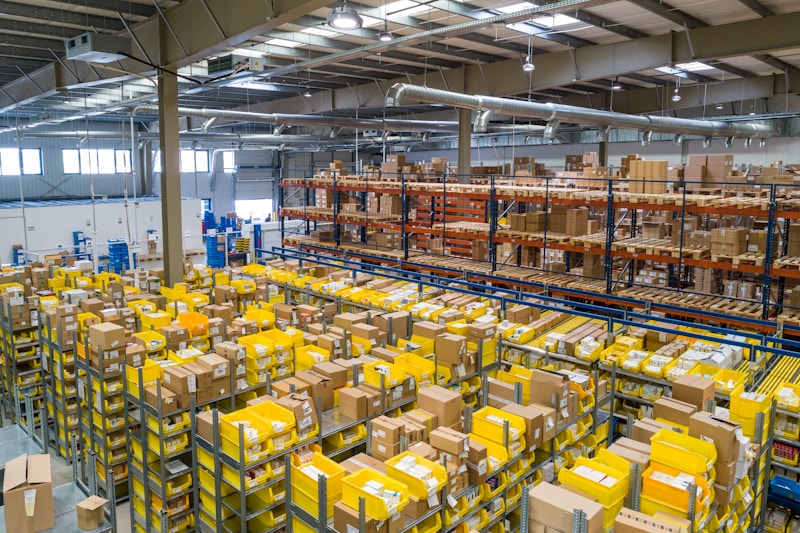
Walk into a major British warehouse today and you might notice something unusual. The forklifts still have human drivers. The loading docks still have human workers. But between the shelving units, rolling quietly and efficiently through the aisles, there are robots — and a growing number of them were made in China.
This is not a future prediction. It is happening right now, in warehouses across the UK, and it raises questions that go well beyond logistics.
The Robots Already in British Warehouses
The company leading the charge is Geek+ — a Chinese robotics firm whose wheeled goods-moving robots are already operating in British distribution centres. These are not humanoids. They are low-profile autonomous mobile robots designed specifically for one job: moving goods from A to B inside a warehouse, faster and cheaper than a human worker with a trolley.
Yanyu Liu, head of communications at Geek+, describes the next step bluntly. The company's goal is end-to-end unmanned warehouse solutions. That means automating picking, handling, and eventually packing goods. The current robots move things. The next generation will handle everything.
The UK is a particularly appealing market for this technology. Productivity pressures in British industry have been a persistent concern. Labour shortages in logistics and warehousing have become acute since 2020. The combination creates exactly the conditions where automated solutions become not just appealing but necessary.
Why China Leads in Warehouse Robotics
China's dominance in this category did not happen by accident. It is the result of deliberate industrial policy, enormous domestic market scale, and aggressive investment that Western competitors struggled to match.
Chinese companies now account for the vast majority of global humanoid robot deployments. But the warehouse robot story predates humanoids — it is built on wheeled autonomous mobile robots (AMRs) and robotic arms that have been refined in China's own enormous logistics sector before being exported globally.
The scale of China's domestic e-commerce — Alibaba, JD.com, Pinduoduo — created demand for warehouse automation that is simply unmatched anywhere else in the world. Chinese robotics companies essentially had a testing ground of billions of orders per year to refine their technology. By the time they came to export it, it was already battle-tested at massive scale.
That is the advantage British companies are now buying into. Not experimental technology. Technology that has already processed billions of orders in Chinese warehouses.
The Geopolitical Tension in the Warehouse
Not everyone is comfortable with this trend. The Chinese embassy in Washington responded to US moves on trade restrictions by saying that Beijing has long opposed the "politicising" of trade issues and sanctions based on "groundless pretexts."
The US has taken a more restrictive approach to Chinese robotics and technology companies than the UK and Europe. Some Chinese robot manufacturers face restrictions or scrutiny in the American market that they do not face in Europe.
For Britain specifically, the question is complicated. Post-Brexit trade policy gives the UK more flexibility than EU member states in some respects. But the fundamental tension — between the genuine efficiency gains that Chinese warehouse robots deliver and the strategic concerns about technology dependence — is one that British policymakers are only beginning to work through.
The warehouses are not waiting for that debate to conclude. The economics are compelling, the labour shortage is real, and the robots are available now.
The Next Frontier — Humanoid Robots
Across China, companies including AgiBot and Unitree are investing billions in humanoid robots — machines designed to look, move, and work like humans.
AgiBot is developing humanoids specifically for tasks carried out by humans in factories. Unitree, which already sells robot dogs and humanoid robots commercially, is scaling production aggressively with a target of producing thousands of units per month.
But here is the honest question the BBC article raises directly, and it is the right one: if wheeled robots move goods cheaply, reliably and efficiently, and robots with just arms can handle other automated tasks — what problem does a humanoid actually solve?
The answer from developers is architectural. Factories, hospitals, offices, and warehouses have all been designed around human bodies. Stairs, door handles, worktables at human height, shelving designed for human reach. A humanoid robot can navigate these environments without requiring the facility to be redesigned around automation.
A wheeled robot needs a warehouse designed for wheeled robots. A humanoid robot, in theory, can work in any building designed for humans.
That is the business case. The honest caveat is that experts and developers alike agree the current technology is not yet suitable for the most repetitive tasks requiring high dexterity. The fine motor control needed to pack fragile items, handle irregular objects, or perform tasks requiring consistent sub-millimetre precision is still being developed.
What This Means for Workers
The productivity argument is straightforward from an employer's perspective. Warehouse automation reduces the number of human workers needed for repetitive movement and picking tasks. For a country facing labour shortages, this can be framed as solving a problem. For workers in those roles, the framing is different.
The robots currently in British warehouses are largely complementary — handling tasks that are hard to staff rather than directly replacing existing workforces. The Geek+ robots in particular work alongside human pickers rather than replacing them entirely.
The phrase to pay attention to is "end-to-end unmanned warehouse solutions." That is not a complementary future. That is a replacement future — for the picking, handling, and packing roles that currently employ hundreds of thousands of workers in British logistics.
How quickly that future arrives depends on how fast the technology improves and how aggressively companies choose to deploy it. Based on the trajectory of Chinese robotic investment, the answer to the first question is: faster than most people expect.
Britain as a Testing Ground
For China's robotics industry, the UK represents something specific and valuable — an English-speaking, logistics-intensive Western market with relatively open trade policy and acute automation demand.
What happens in British warehouses over the next three to five years will demonstrate whether Chinese warehouse and logistics robots can scale successfully in Western markets. Success in the UK makes the case for deployment across Europe and potentially the USA, even as American trade restrictions complicate direct entry into that market.
Britain's warehouses are, in the BBC's own framing, becoming an early testing ground for China's next major technology export.
The first major technology export was consumer electronics — smartphones, laptops, manufacturing components. The second was solar panels and electric vehicles. The third may well be robots.
And unlike solar panels, robots come with persistent software dependencies, connectivity requirements, and the data flows that come with any AI-powered system operating in a commercial environment. The geopolitical conversation about Chinese warehouse robots is only going to get more complicated from here.
The Simple Summary
What is happening right now:
→ Chinese-made warehouse robots (Geek+)
   already operating in UK warehouses

→ Goal: end-to-end unmanned warehouses
   (picking, handling, packing — all automated)

→ AgiBot and Unitree investing billions
   in humanoid robots for factories

→ China accounts for majority of global
   humanoid robot deployments

Why UK:
→ Labour shortages in logistics
→ Productivity pressure
→ More open trade policy than USA
→ Large logistics sector

The tension:
→ Real efficiency gains vs
   strategic technology dependence
→ US restricting Chinese robots
→ UK currently more open

What comes next:
→ Humanoids in warehouses
   (years away, not decades)
→ Geopolitical debate intensifying
→ More British jobs automated
→ UK becomes test case for
   Chinese robot global expansion
TheTechGenAI Studios — We Track the Shifts That Matter
At TheTechGenAI Studios, we cover the technology stories that are reshaping industries and economies — from Chinese robots in British warehouses to AI tools that help Indian businesses compete globally.
If you are a business looking to understand how AI and automation affect your industry, or you need an AI-powered digital presence that keeps pace with how fast things are moving — we are here to help.
📧 [email protected] 📱 +91 98704 05692 🌐 thetechgenai.com
FAQs
Are Chinese robots really working in British warehouses? Yes. Chinese robotics company Geek+ has robots operating in UK distribution centres, moving goods autonomously. The company's stated goal is end-to-end unmanned warehouse solutions covering picking, handling, and packing.
Which Chinese companies are leading in warehouse and humanoid robots? Geek+ leads in warehouse logistics robots currently deployed in the UK. AgiBot and Unitree are the major Chinese companies investing billions in humanoid robots for factory applications.
Why is China dominant in warehouse robotics? China's massive domestic e-commerce sector — Alibaba, JD.com, Pinduoduo — created the scale needed to develop and refine warehouse robotics at a level no other country matched. By the time Chinese companies exported the technology, it had already been tested on billions of orders.
What is the difference between warehouse robots and humanoid robots? Current warehouse robots are wheeled or arm-based — designed for specific tasks in purpose-built environments. Humanoid robots are designed to work in any environment built for humans, without requiring facilities to be redesigned around automation.
Why are humanoids not yet replacing warehouse workers? Current humanoid technology lacks sufficient dexterity for the most repetitive fine-motor tasks. Experts describe humanoids as complementary to existing automation rather than a direct replacement in the near term.
What is the geopolitical concern about Chinese warehouse robots in the UK? Beyond trade tensions, AI-powered robots operating in commercial environments generate operational data and have software dependencies. The strategic implications of widespread Chinese robot deployment in Western logistics infrastructure is a growing area of policy concern.