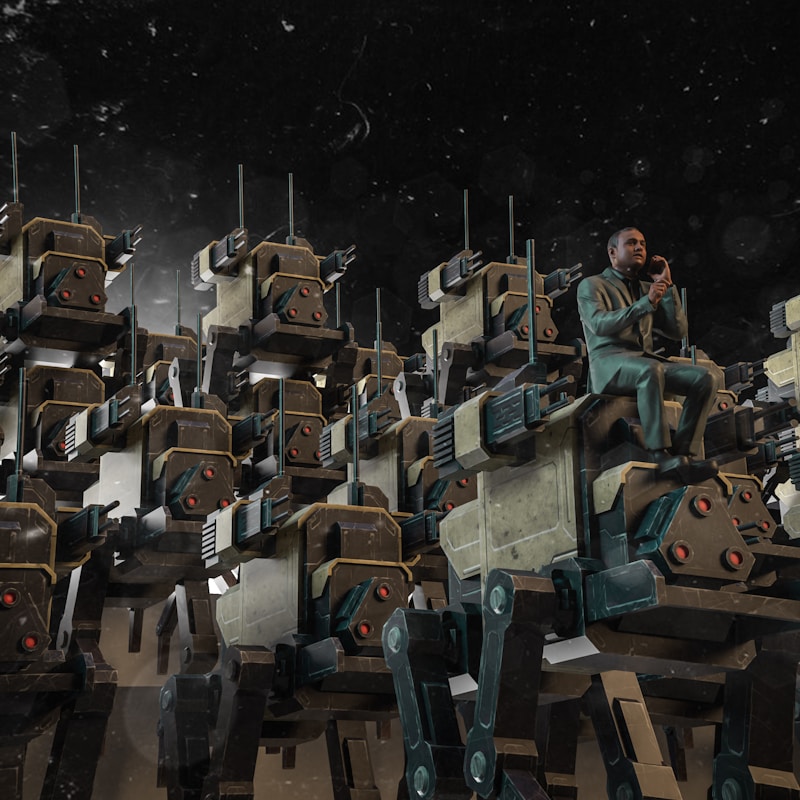
In James Cameron's Avatar, the humans operating on Pandora wore massive mechanical suits called AMP suits — Amplified Mobility Platforms. Twelve feet tall. Controlled by a human pilot sitting inside. Capable of carrying heavy weapons, moving through rough terrain, and replicating every movement of the human inside with mechanical precision.
They were terrifying. They were also, in the context of 2009, entirely fictional.
Fast forward to October 2025. TIME Magazine puts a robot on the cover of its Best Inventions issue. Not a concept. Not a render. A real robot, built by a real company, that had already spent ten months working a production line at a BMW factory.
The robot is called Figure 03. The company is called Figure AI. And the more you look at it standing there on the TIME cover — gunmetal grey, five feet six inches tall, expressionless dome for a face — the more you think about those AMP suits from Avatar.
Not because Figure 03 is a weapon. It is not. But because the visual and technological journey from here to there is shorter than most people are comfortable admitting.
What TIME Magazine Actually Saw
The TIME reporter visited the Silicon Valley headquarters of Figure AI on an August morning in 2025. Two humanoid robots with bulbous joints and expressionless plastic domes for faces stood at a desk. In front of each was a crumpled towel and to its right a basket. In slow movements each robot grabbed a towel by its corners, flattened it out, folded it twice, and deposited it into the basket. More often than not the towel caught on the edge of the basket and the robot froze. Then an engineer stepped in and returned the towel to a crumpled heap and the sequence began again.
This is the honest picture. Not the polished YouTube video. The real thing, in an office, watched by a journalist who reported exactly what happened — including the engineer with the litter-picker who grabbed fallen laundry and hid it behind the machine when the robot dropped it.
Figure AI's latest unveiling, featured on the cover of TIME as one of its Best Inventions of 2025, signals how close humanoid robots are to entering homes. Still, even the magazine admits — Figure 03 will not be ready for home use upon its release.
So we have a robot on the cover of TIME Magazine that cannot yet reliably fold a towel. And that is somehow simultaneously honest and extraordinary — because the gap between "cannot reliably fold a towel" and "working a BMW production line for ten months" is enormous, and Figure 03 has already crossed that second threshold.
What is Figure 03 — The Complete Picture
Figure AI has unveiled Figure 03, its third-generation humanoid robot designed for mass production and deployment in both homes and commercial settings. Figure 03 represents a significant leap from experimental prototypes to a scalable, general-purpose product. TIME Magazine named Figure 03 one of the best inventions of 2025. The robot is engineered for high-volume manufacturing at the company's new BotQ facility and is deeply integrated with its proprietary Helix AI.
The Hardware
Much of Figure 03's enhancements are specifically designed for better, safer home use. Even the look is softer and less out of place in a household setting — almost the entire body is now covered in a soft mesh fabric.
A new vision system delivers twice the frame rate and a quarter of the latency of its predecessor, with a 60% wider field of view per camera. This gives Helix a denser, more stable perceptual stream for navigating complex spaces. The hands feature embedded palm cameras for maintaining visual awareness in confined spaces. They also include internally developed tactile sensors sensitive enough to register the weight of a paperclip.
That last detail is remarkable. Sensitive enough to register the weight of a paperclip. That level of tactile sensitivity is what allows the robot to handle fragile objects — a glass, an egg, a medication bottle — without crushing or dropping them.
The AI — Helix
This move followed a strategic pivot in February 2025 when Figure ended its collaboration with OpenAI to build a specialized AI for robotics. Helix integrates vision, language, and action, allowing the robot to learn from its environment.
Figure AI built its own AI. Not ChatGPT. Not any external model. Their own system, called Helix, designed specifically for a body that moves through physical space and interacts with physical objects. Helix learns by watching humans do things, then replicates those movements with increasing accuracy over time.
The Factory
Figure redesigned its assembly line to use die-casting and injection moulding instead of complex machining, reducing cost and build time. Its new factory, BotQ, can produce 12,000 robots annually and expects to ramp up to 100,000 within four years.
100,000 robots per year within four years. That is not a prototype operation. That is mass manufacturing — the same industrial logic that made smartphones universal by driving costs down through volume.
The Valuation
Figure AI is now one of Silicon Valley's buzziest and most valuable startups, having raised $1 billion at a $39 billion valuation.
Figure AI was founded in 2022 by Brett Adcock, also known for founding Archer Aviation and Vettery.
Three years old. $39 billion valuation. One billion dollars raised. Robot already deployed in a BMW factory.
What Figure 03 Can Actually Do Right Now
This is important to be honest about. The YouTube videos and the TIME cover create an impression of a robot that is almost ready to walk into your house and start helping. The reality is more nuanced — and in some ways more impressive than the surface story suggests.
What it can do:
- Fold laundry (imperfectly, but improving rapidly)
- Load a dishwasher
- Press buttons on washing machines and appliances
- Serve food and drinks
- Play with a family dog (this genuinely happened in the demo video)
- Place sheet metal parts into welding fixtures at a BMW factory — consistently, for ten months
What it cannot do yet:
- Navigate a truly unstructured home environment reliably
- Handle unexpected situations without human intervention
- Be purchased by a consumer
- Work without engineers nearby to handle edge cases
A few hundred miles south of Figure's headquarters, a different Figure robot had spent the previous ten months on the production line at BMW's Spartanburg, South Carolina plant, placing sheet metal parts into welding fixtures. It contributed to more than 30,000 vehicles.
Thirty thousand vehicles. That is not a demo. That is real industrial output from a humanoid robot working alongside humans in a car factory.
Avatar's AMP Suits — The Comparison That Matters
In Avatar, the AMP suits were tools of war built for a specific, brutal purpose — carrying heavy weapons across the terrain of Pandora and allowing human soldiers to match the physical power of the Na'vi.
But strip away the weapons and the context, and what you have is a human-controlled mechanical system that amplifies human capability, replicates human movement with mechanical precision, and operates in environments built for human-scale interaction.
That is exactly what Figure 03 is — minus the weapons and the twelve-foot scale.
| Avatar AMP Suit | Figure 03 |
|---|---|
| Human-scale mechanical system | ✅ 5 ft 6 inches — human scale |
| Replicates human movement | ✅ Helix AI learns from human motion |
| Operates in human environments | ✅ Designed for homes and factories |
| Precision manipulation | ✅ Tactile sensors feel a paperclip |
| Purpose-built AI control | ✅ Helix vision-language-action model |
| Mass produced | ✅ BotQ factory — 12,000/year target |
| Weapons systems | ❌ No (obviously) |
| 12 feet tall | ❌ Human height |
| Controlled by human inside | ❌ Controlled by AI (Helix) |
The trajectory from Figure 03 to an AMP-style system is not as long as it seems. The AMP suit is essentially a Figure 03 that has been scaled up, given a human pilot seat, and optimised for outdoor terrain rather than home environments. The underlying concept — a human-scale or larger mechanical system doing physical work — is the same.
The direction is clear. The question is not whether humanoid robots become capable of more powerful physical tasks. It is how quickly.
Figure 03 at the White House
By 2026, the robots demonstrated the potential ability to perform household work and the company gained publicity when a Figure 03 appeared at a White House event.
A humanoid robot appeared at a White House event in 2026. This is the kind of sentence that would have been dismissed as science fiction five years ago. It is now a factual statement about something that happened this year.
The Honest Question Nobody Wants to Ask
If Figure AI succeeds — if BotQ scales to 100,000 robots per year, if Helix gets good enough to navigate any home environment reliably, if the price comes down to something consumers can afford — what does that world look like?
The optimistic version: a robot that handles all physical household tasks while humans focus on creative, social, and intellectual work. Every family has a Figure in the kitchen and the laundry room. Elderly people maintain independence longer because their robot handles tasks they can no longer physically manage.
The uncomfortable version: every factory job, every warehouse job, every logistics job, every domestic service role — done by robots. At 100,000 units per year, scaling to millions over a decade, the labour market disruption would be unlike anything since the Industrial Revolution.
Figure AI is an audacious startup that hopes to one day be the biggest business on the planet. The launch made it clearer than ever that the vast optimism of the AI boom is spilling over into robotics. Dozens of companies are now competing to make the world's first viable humanoid robot, convinced that recent advances in AI have made what was once a pipe dream into achievable reality.
The world's biggest business. That is what Figure AI's founder Brett Adcock is building toward. Not the world's biggest robotics company. The world's biggest business — period.
If humanoid robots become as universal as smartphones, and every human on Earth eventually has one or interacts with one daily, that ambition is not unreasonable.
What Comes Next for Figure AI
The Figure 03 is not available for consumer purchase. The timeline for home deployment is genuinely unclear — even TIME's own coverage admitted the robot was not ready for home use at launch.
The next phase is more factory deployments, more months of real-world data collection, more Helix training on actual human environments. Every hour a Figure robot spends folding laundry or loading dishwashers in a test environment makes Helix smarter at folding laundry and loading dishwashers.
The AMP suit comparison is useful here. In Avatar, those suits did not appear overnight. They were the result of decades of engineering development, each iteration more capable than the last. Figure 03 is not the endgame. It is an early iteration in a development arc that may run for decades.
But it is on the cover of TIME Magazine. It is in a BMW factory. A Figure robot stood in the White House.
The arc has started.
TheTechGenAI Studios — We Track the Technology That Changes Everything
At TheTechGenAI Studios, we follow AI and robotics stories like Figure 03 because the same underlying technology — computer vision, language models, physical AI — is what we use to build digital solutions for businesses across India.
From AI-powered websites to digital marketing strategies that work in 2026 — we bring the same spirit of applied technology to your business at a scale that makes sense.
Talk to us about your project — free consultation, no commitment.
📧 [email protected] 📱 +91 98704 05692 🌐 thetechgenai.com
FAQs
What is Figure 03? Figure 03 is a third-generation humanoid robot built by Figure AI, a San Jose-based startup founded in 2022. It was named one of TIME Magazine's Best Inventions of 2025 and was featured on the cover of TIME's Best Inventions issue.
What can Figure 03 actually do in 2026? Figure 03 can fold laundry, load dishwashers, serve food, press appliance buttons, and handle industrial tasks. A predecessor model spent ten months on a BMW production line contributing to over 30,000 vehicles.
Who makes Figure 03 and what is the company worth? Figure AI, founded by Brett Adcock in 2022, makes Figure 03. The company has raised $1 billion at a $39 billion valuation as of late 2025. It is headquartered in San Jose, California.
What AI powers Figure 03? Figure 03 runs on Helix — Figure AI's proprietary vision-language-action model built in-house after the company ended its collaboration with OpenAI in February 2025. Helix learns from observing human behaviour.
How does Figure 03 compare to Avatar's AMP suits? Both are human-scale mechanical systems designed to operate in human environments, replicate human movement with precision, and handle physical tasks. Figure 03 uses AI rather than a human pilot and is designed for domestic and industrial use rather than combat.
Can I buy a Figure 03 robot? No. Figure 03 is not currently available for consumer purchase. The company acknowledged at launch that the robot was not yet ready for home use and that achieving home deployment would require significant additional development.