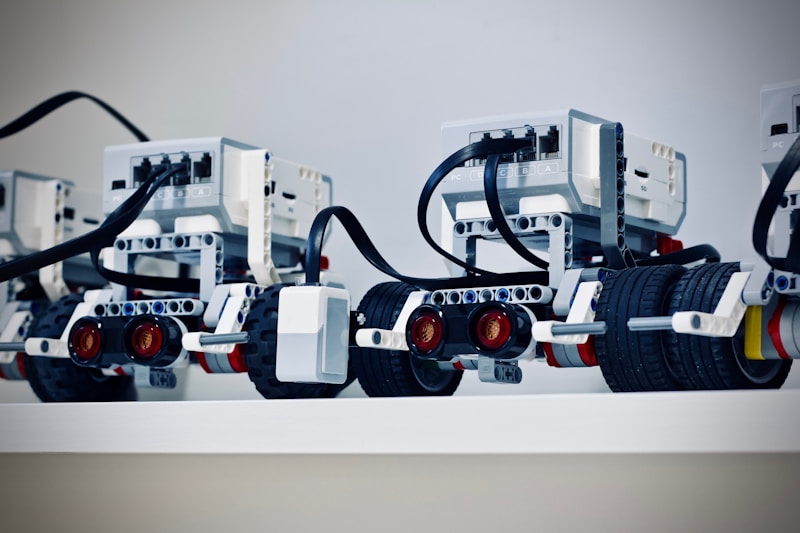
The world's factories are running out of people.
Not because of some sudden crisis — because of a slow, decades-long demographic shift that has been building across the USA, Germany, Japan, South Korea, and China simultaneously. Manufacturing jobs go unfilled. Production lines need to keep moving. And the solution the world's largest manufacturers have overwhelmingly chosen is industrial robots.
The industrial robotics market value is projected at $65.1 billion in 2026 and is anticipated to reach $343.8 billion by 2036, growing at 18.1% annually.
That is a market that could more than quintuple in ten years. To understand why — and which robots are driving it — you need to understand what industrial robots actually are, which types are most in demand, who makes them, what they cost, and where AI is taking the entire category.
The Numbers — How Big is the Industrial Robot Market in 2026
The industrial robotics market is valued at $15.5 billion in 2026 and is projected to reach $20.8 billion by 2032. The Asia Pacific region accounted for 67.3% of revenue in 2025.
Manufacturing labour shortages across the USA, Germany, Japan, and South Korea are creating structural demand for robotic automation, with unfilled manufacturing positions exceeding 500,000 in the USA alone.
The United States is forecast to generate the highest revenue in the robotics market with an expected value of $9.88 billion in 2026.
The world's factories install more than 500,000 new industrial robots in a typical year and demand has roughly doubled over the past decade.
Half a million new robots installed every year. Doubled demand over ten years. And a labour shortage in every major manufacturing economy pushing companies toward automation faster than ever before.
The three biggest demand drivers right now:
EV battery and electronics manufacturing scaling is creating new high-volume robot installation segments beyond traditional automotive body welding, with gigafactory and semiconductor fab buildout requiring thousands of robots per facility.
Electric vehicles, AI chips, and smartphones — the three fastest-growing manufacturing categories in the world — all require industrial robots at massive scale. Every new Tesla gigafactory, every new TSMC semiconductor fab, every new Samsung display plant needs thousands of robots to operate.
Types of Industrial Robots — What is Most In Demand
Not all industrial robots are the same. There are six major types, each designed for different tasks. Understanding which type is most demanded tells you where manufacturing is actually heading.
1. Articulated Robots — The Most Popular Type
The product type segment accounted for 49.0% of articulated robots in 2026 as 4 to 7 axis configurations provide the flexibility required for automotive, general manufacturing and heavy payload applications.
Articulated robots look like a mechanical arm — multiple joints rotating on different axes, mimicking the human arm's range of motion. They are the most versatile type, capable of welding, painting, assembly, material handling, and almost any other task requiring flexible movement in three-dimensional space.
Why most demanded: Flexibility. One articulated robot can be reprogrammed for different tasks as production needs change. In an industry being disrupted by EV transition and shifting consumer demand, flexible robots are worth their premium.
Price range: $25,000 to $400,000+ depending on payload and reach
Who makes them: FANUC, ABB, KUKA, Yaskawa — all four industrial robot giants lead here
2. Collaborative Robots (Cobots) — The Fastest Growing
Collaborative robots are gaining faster adoption across SMEs and flexible production lines.
Collaborative robot adoption is expanding the addressable market to small and medium manufacturers by reducing integration complexity, cost, and safety fencing requirements compared to traditional industrial robots.
Cobots are designed to work directly alongside humans without safety caging. They have built-in sensors that detect contact and stop immediately. They are lighter, smaller, and easier to programme than traditional industrial robots — often using simple teach-by-demonstration where a worker physically guides the robot through a movement once, and the robot memorises and replicates it.
The cobot revolution is important because it takes industrial robotics from something only large manufacturers could afford and implement, to something accessible to the small factory, the medium-sized producer, the craft manufacturer who needs some automation but cannot afford to build a fully automated production line.
Why most demanded: Accessible pricing, no safety caging required, easy to redeploy for different tasks, suitable for smaller facilities
Price range: $15,000 to $80,000
Who makes them: Universal Robots (market leader), FANUC, ABB, KUKA, Techman Robot
3. SCARA Robots — Electronics Assembly Kings
SCARA (Selective Compliance Articulated Robot Arm) robots are specialised for high-speed horizontal assembly — the kind of precise, rapid pick-and-place operations that electronics manufacturing requires.
Low payload robots under 20kg hold the highest share, accounting for approximately 54.20% of revenue share in 2026. This largest share is due to their widespread utilisation in the packaging of goods within the medical devices, pharmaceuticals, and cosmetics sectors where precision, cleanroom compliance, and compact form factors are non-negotiable.
SCARA robots are extraordinarily fast at repetitive tasks — placing components on a circuit board, packing products into containers, sorting small parts. Speed measured in thousands of cycles per hour. Precision measured in fractions of a millimetre.
Why most demanded: Electronics and semiconductor manufacturing boom — every AI chip requires precision assembly
Price range: $10,000 to $60,000
Who makes them: Epson (market leader for SCARA), FANUC, Yamaha, Denso
4. Delta Robots — Packaging Specialists
Delta robots are the spidery-looking machines suspended from a frame above a conveyor belt, grabbing and placing items at extraordinary speed. They are the robots you see in food packaging lines, pharmaceutical blister pack filling, and confectionery production.
Robots with required TCP speed above 2,000mm/s or cycle times under 2 seconds narrow the field to high-speed specialised arms — some Delta robots for pick-and-place, or specific 6-axis models designed for rapid motion.
Delta robots can perform 150 to 200 pick-and-place cycles per minute. Nothing else comes close for this specific application.
Why most demanded: Food, beverage, pharmaceutical, and e-commerce packaging — all growing categories
Price range: $20,000 to $100,000
Who makes them: Fanuc, ABB, Codian Robotics
5. Cartesian / Gantry Robots — Linear Precision
Cartesian robots move on three linear axes — X, Y, and Z. They are simpler than articulated robots but excel at applications requiring straight-line precision over large work areas — CNC machine tending, 3D printing, large-format assembly.
Why most demanded: EV battery assembly requires large-format precision placement — gantry robots handle this at scale
Price range: $10,000 to $200,000
6. Cylindrical and Spherical Robots — Specialised Applications
These older robot types are increasingly niche — used for specific applications where their particular movement range is an advantage. Arc welding and assembly in cylindrical workspaces.
Market share: Declining relative to articulated and cobot alternatives
The Most In-Demand Industrial Robots Worldwide in 2026
Based on installation volumes, market share data, and industry deployment reports:
Most In-Demand: Universal Robots UR Series (Cobots)
Universal Robots, a Danish company now owned by Teradyne, makes the world's most widely deployed collaborative robots. The UR5, UR10, and UR16 are found in more facilities across more countries than any other cobot brand.
Why most in demand globally:
- Easiest to programme and redeploy
- No safety caging required
- Works in facilities too small for traditional industrial robots
- Huge ecosystem of third-party accessories and integrations
- Proven reliability across hundreds of thousands of deployments
Key models:
- UR3e: $23,000 — table-mounted, small assembly tasks
- UR5e: $35,000 — most popular model, 5kg payload
- UR10e: $45,000 — 10kg payload, wider reach
- UR16e: $55,000 — 16kg payload, heavier tasks
- UR20: $65,000 — 20kg payload, new for 2025-2026
- UR30: $80,000+ — 30kg payload, heavy cobot tasks
Most In-Demand Traditional Industrial Robot: FANUC
FANUC Corporation led with over 8% market share in 2025. Top 5 players including FANUC Corporation, ABB Ltd, Yaskawa Electric Corporation, KUKA, and Teradyne collectively held 30% market share in 2025.
FANUC is the world's most installed industrial robot brand — Japanese precision engineering applied to manufacturing automation. Their yellow robots are found in more car factories, electronics plants, and production facilities than any other brand worldwide.
Why most in demand for traditional industrial applications:
- Unmatched reliability — FANUC robots routinely operate for 20+ years
- Largest installed base means largest parts and service ecosystem
- Dominant in automotive — the world's largest robot application sector
- Strong AI integration with FANUC FIELD system and latest AI vision
Key models and prices:
- FANUC M-1iA: $15,000-$25,000 — miniature delta robot for small parts
- FANUC M-10iA: $30,000-$50,000 — versatile mid-range 6-axis
- FANUC M-20iD: $40,000-$65,000 — most popular general purpose
- FANUC R-2000iD: $80,000-$120,000 — heavy payload automotive
- FANUC M-900iB: $120,000-$200,000 — ultra-heavy payload
Most In-Demand in Electronics: Epson SCARA Robots
ABB and Epson lead near 13% each in market share, FANUC follows at approximately 11%.
Epson — yes, the printer company — is actually one of the world's largest industrial robot manufacturers. Their SCARA and 6-axis robots dominate electronics assembly, semiconductor manufacturing, and pharmaceutical packaging globally.
Key models:
- Epson T3: $8,000-$15,000 — entry level SCARA
- Epson T6: $15,000-$25,000 — versatile SCARA
- Epson LS6-B: $20,000-$35,000 — cleanroom SCARA
- Epson C8: $25,000-$45,000 — 6-axis for electronics
Most In-Demand in Automotive: ABB IRB Series
ABB, the Swiss-Swedish engineering giant, leads in automotive painting and large-scale assembly applications. Their IRB series is the standard for car factory automation across Europe and North America.
Key models:
- ABB IRB 1200: $25,000-$45,000 — compact assembly
- ABB IRB 4600: $50,000-$80,000 — automotive assembly
- ABB IRB 6700: $90,000-$150,000 — heavy automotive
- ABB IRB 8700: $150,000-$250,000 — ultra-heavy payload
Complete Industrial Robot Price Guide 2026
Payload is the single strongest predictor of robot arm price. Unit average selling price for Chinese-branded robots is now approximately 30-40% below the global average, compressing margins for Japanese and European OEMs and creating significant price transparency pressure across all tiers.
| Robot Type | Payload | Price Range | Best Application |
|---|---|---|---|
| Collaborative (cobot) | 3-30kg | $15,000-$80,000 | SME manufacturing |
| SCARA | 1-20kg | $8,000-$60,000 | Electronics assembly |
| Delta | 1-15kg | $20,000-$100,000 | Food packaging |
| Articulated (small) | 3-20kg | $25,000-$70,000 | General assembly |
| Articulated (mid) | 20-80kg | $50,000-$120,000 | Automotive, handling |
| Articulated (heavy) | 80-300kg | $90,000-$250,000 | Heavy automotive |
| Articulated (ultra) | 300kg+ | $150,000-$400,000 | Aerospace, heavy industry |
These are robot arm prices. A complete working robot cell — controller, end effector, safety systems, installation, and integration — typically costs 2 to 3 times the robot arm price.
Where is Demand Highest Globally
Asia Pacific dominated the industrial robots market with a 48.7% share in 2025. Europe captured 29.90% of the global market. North America accounted for 18.90%.
China — The Largest Single Market
China installs more industrial robots per year than any other country. Domestic Chinese brands — Estun, Inovance, and AUBO — are growing rapidly and competing directly with Japanese and European brands on price. The clearest pressure comes from China, now the largest single market for industrial robots and home to fast-growing domestic brands such as Estun and Inovance that already lead at home and are climbing the worldwide table.
USA — Fastest Growth Rate
The USA leads on 17.1% CAGR, driven by reshoring investment, CHIPS Act semiconductor fab construction and EV gigafactory buildout creating concentrated robot demand.
The combination of the CHIPS Act (subsidising semiconductor manufacturing on US soil) and the EV transition (creating new gigafactory construction) is making the USA the fastest-growing major market for industrial robots in 2026.
Japan — The Manufacturing Base
Japan at 16.9% CAGR reflects the world's largest robot manufacturing base (FANUC, Yaskawa, Kawasaki) and domestic automotive and electronics manufacturing robot density growth.
Japan manufactures most of the world's industrial robots while also deploying them heavily domestically. FANUC, Yaskawa, Kawasaki, and Denso all have their manufacturing operations in Japan.
Germany — European Industrial Leader
Germany remains the dominant European market, driven by its automotive sector — BMW, Mercedes-Benz, Volkswagen — and its strong industrial machinery manufacturing base.
AI is Changing What Industrial Robots Can Do
The biggest shift in industrial robotics in 2026 is not hardware. It is software and AI.
Traditional industrial robots follow pre-programmed paths. Every movement is defined. Every position is fixed. Change anything — product design, component placement, production volume — and a human programmer has to spend days or weeks reprogramming the robot.
AI-powered industrial robots are beginning to change this fundamentally.
AI Vision — Cameras combined with machine learning allow robots to identify parts regardless of orientation, detect defects in real time, and adapt to variation in component placement without reprogramming.
Physical AI — The broader trend that NVIDIA, KUKA, ABB, FANUC, and Yaskawa are all investing in — robots that understand goals (intent) rather than just instructions. Tell the robot what you want done; it figures out how.
Digital twins — NVIDIA Omniverse allows manufacturers to simulate complete robot cells and production lines digitally before physical deployment. Test, optimise, and validate in simulation. Deploy in reality.
FMI analysts perceive the market evolving toward Physical AI platforms where vision-guided, language-instructed robots replace traditionally programmed motion control systems, with software differentiation surpassing hardware specifications.
In simple terms — the software running on industrial robots is becoming more important than the hardware. The robot arm itself is increasingly a commodity. The AI that makes it intelligent is the differentiator.
Robot-as-a-Service (RaaS) — Making Robots Accessible
One development changing who can afford industrial robots is the rise of Robot-as-a-Service (RaaS).
Instead of purchasing a $100,000 robot outright, manufacturers pay a monthly subscription fee — typically $3,000 to $10,000 per month — for a robot that is deployed, maintained, and upgraded by the provider.
Increasing demand for Robot-as-a-Service (RaaS) is one of the key trends shaping the AI-powered industrial robot market in 2026.
For small and medium manufacturers who cannot justify a large capital expenditure, RaaS removes the barrier entirely. The robot appears in your facility. You pay monthly. If the robot needs maintenance, the provider handles it. If a better model becomes available, you upgrade.
This model is rapidly expanding access to industrial robotics beyond the large manufacturers who have historically dominated robot deployment.
TheTechGenAI Studios — We Apply AI at Every Scale
At TheTechGenAI Studios, we follow the AI and robotics developments reshaping global manufacturing — because the same underlying technology that is transforming factories is what we use to build intelligent digital solutions for businesses.
Whether you are a manufacturer thinking about industrial automation or a business owner who needs an AI-powered website that works for you around the clock — the principle is the same: technology doing the work so you can focus on what matters.
Talk to us about your project. Free consultation, no commitment.
📧 [email protected] 📱 +91 98704 05692 🌐 thetechgenai.com
FAQs
What is the industrial robots market size in 2026? The industrial robotics market is valued at approximately $65.1 billion in 2026, projected to reach $343.8 billion by 2036, growing at 18.1% annually.
What is the most in-demand industrial robot in 2026? Collaborative robots (cobots) are the fastest-growing segment, with Universal Robots leading globally. For traditional industrial applications, FANUC leads with over 8% market share. Articulated robots overall account for 49% of all industrial robot installations.
How much does an industrial robot cost in 2026? Prices range from $8,000 for basic SCARA robots to over $400,000 for heavy-payload articulated robots. Collaborative robots typically cost $15,000 to $80,000. Chinese-branded robots are 30-40% cheaper than Japanese and European equivalents.
Which country uses the most industrial robots? China is the largest single market for industrial robot installations. Asia-Pacific overall accounts for nearly 67% of global market revenue. The USA is the fastest-growing market driven by semiconductor fab construction and EV gigafactory buildout.
What are the top industrial robot manufacturers in 2026? ABB and Epson lead with approximately 13% market share each. FANUC follows at 11%. KUKA and Yaskawa round out the top five. Together the top five hold approximately 30% of global market share.
What is Robot-as-a-Service (RaaS)? RaaS is a subscription model where manufacturers pay a monthly fee ($3,000 to $10,000) for industrial robots rather than purchasing them outright. The provider handles deployment, maintenance, and upgrades. This model is expanding access to industrial robotics for small and medium manufacturers.