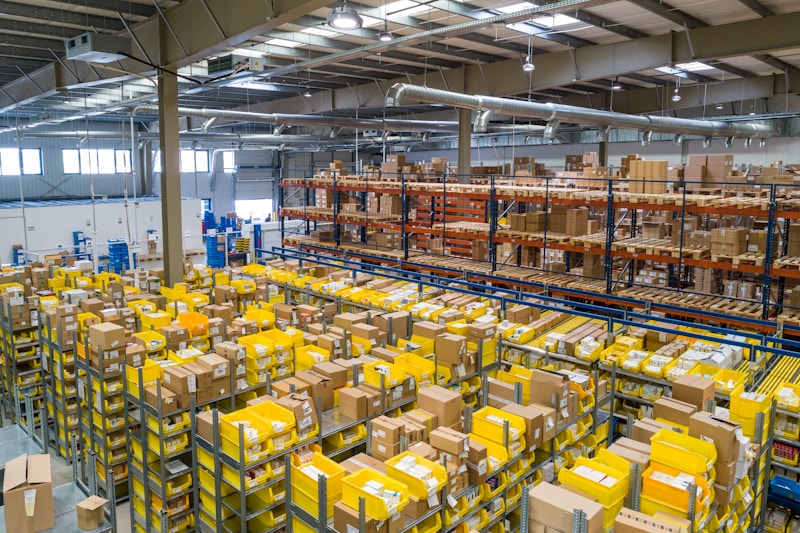
Something changed in warehouses, factories, and hospitals over the last three years that most people outside those industries have not noticed yet.
The forklifts still look the same. The shelving units are the same. The loading docks have not changed. But moving through the aisles, carrying goods from one station to another, navigating around workers and obstacles without instruction, are a new category of machine that did not meaningfully exist at commercial scale just five years ago.
Autonomous Mobile Robots. AMRs.
Not robots on fixed tracks. Not robots following magnetic strips on the floor. Robots that understand their environment, navigate it in real time, make decisions about how to get from A to B, and adapt when something is in the way.
According to MarketsandMarkets' latest 2026 report, the global AMR market has reached $2.75 billion and is expected to grow to $7.07 billion by 2032, with a compound annual growth rate of 14.4%. The surge in e-commerce, labour shortages, and the adoption of Industry 4.0 are the main growth drivers.
That is a market nearly tripling in six years. Here is everything you need to know about it.
What is an Autonomous Mobile Robot — The Simple Explanation
Before diving into companies and prices, it helps to understand what makes an AMR different from other robots and other automation systems.
Traditional Automated Guided Vehicles (AGVs) follow fixed paths — magnetic strips, laser reflectors, or physical tracks embedded in the floor. They are reliable and efficient in environments designed around them. But if something is blocking the path, an AGV stops and waits for a human to clear it. If the layout of the facility changes, the infrastructure needs to be reinstalled.
Autonomous Mobile Robots carry their own map of the environment and navigate in real time. They use LiDAR, cameras, ultrasonic sensors, and AI to understand where they are, where everything else is, and how to reach their destination. If something blocks their path, they reroute around it automatically. If the facility layout changes, they remap it.
These systems leverage machine learning algorithms to process data from LiDAR, cameras, and ultrasonic sensors, reducing navigation errors by up to 40% compared to earlier models.
The practical difference matters enormously. An AGV installation requires weeks of infrastructure work. An AMR can be deployed in days. An AGV stops when a pallet is misplaced. An AMR navigates around it. An AGV requires a fixed facility layout. An AMR adapts.
The AMR Market in 2026 — Key Numbers
The global autonomous mobile robots market size was valued at USD 2.77 billion in 2025, projected to grow from USD 3.20 billion in 2026 to USD 10.36 billion by 2034, exhibiting a CAGR of 15.80%.
North America dominated the autonomous mobile robots market with a share of 37.3% in 2025. The logistics and 3PL industry is expected to register the highest CAGR of 16.7% during the forecast period.
Europe dominated the global autonomous mobile robots market with a market share of 35.32% in 2025 due to strong adoption in smart factories and logistics.
Three facts worth noting:
The market is genuinely global — North America and Europe both claim dominance depending on which report you read, because both markets are large and growing rapidly. Asia-Pacific is the fastest-growing region.
Logistics is the dominant application — warehouses, distribution centres, and 3PL providers are the primary buyers. E-commerce growth means more goods moving more frequently through more facilities.
Labour shortage is the structural driver — every major economy is experiencing warehouse and logistics labour shortages. AMRs are not replacing workers in large numbers yet — they are filling positions that cannot be filled with human workers.
The Top AMR Companies in 2026
Market leaders hold about 40-50% share collectively amid rapid growth.
Here are the companies that matter:
1. Geek+ — The Market Leader
Geek+ is one of the fastest-growing warehouse robotics companies, maintaining the top global AMR market share for seven consecutive years, with a 48.5% share in goods-to-person solutions according to Interact Analysis 2026. The company offers full-stack AMR solutions including picking robots, sorting systems, and pallet handling robots. Its AI cloud scheduling platform allows rapid deployment and dynamic task optimisation.
Geek+ is Chinese-headquartered and operates globally — including the UK warehouse deployments we covered in our earlier post about Chinese robots entering British logistics. Their dominance in goods-to-person solutions is extraordinary — nearly half the global market for this specific application.
What Geek+ makes:
- Goods-to-person picking robots
- Sorting robots for distribution
- Pallet handling AMRs
- Full warehouse management software
Price range: $15,000 to $80,000 per robot depending on model
Best for: E-commerce fulfilment, distribution centres, high-volume picking operations
2. Mobile Industrial Robots (MiR) — The Collaborative Specialist
Mobile Industrial Robots (MiR) is a global leader in collaborative AMRs, focusing on internal logistics transport within factories and warehouses. MiR robots work safely alongside human workers. Their product line ranges from MiR100 for light loads to MiR1350 for heavy pallet handling, supporting safe human-robot collaboration and modular attachments. Deployment is quick and integration is simple.
MiR is a Danish company — now owned by Teradyne (the same company that owns Universal Robots cobots). Their robots are known for being genuinely easy to deploy and programme, with a modular design that allows different attachments for different tasks.
MiR Product Line:
| Model | Payload | Speed | Best For | Price |
|---|---|---|---|---|
| MiR100 | 100kg | 1.5 m/s | Light transport | $25,000-$35,000 |
| MiR250 | 250kg | 2.0 m/s | Mid-weight transport | $35,000-$50,000 |
| MiR600 | 600kg | 2.0 m/s | Heavy transport | $50,000-$75,000 |
| MiR1350 | 1,350kg | 1.2 m/s | Pallet handling | $75,000-$100,000 |
Best for: Manufacturing internal logistics, hospital transport, factory floor automation
3. OTTO Motors — The Heavy Industry Specialist
OTTO Motors develops industrial-grade heavy-duty AMRs, accumulating over 10 million production hours (2025-2026) and winning the IERA Innovation Award. Their robots feature high payload capacity and precise path planning, integrated with Rockwell Automation's systems.
OTTO Motors (now part of Rockwell Automation) focuses on the heaviest and most demanding AMR applications — automotive plants, aerospace facilities, heavy manufacturing. Ten million production hours accumulated means these robots have been tested and proven in some of the most demanding industrial environments in the world.
Price range: $60,000 to $150,000
Best for: Automotive manufacturing, heavy industry, facilities already using Rockwell Automation systems
4. Locus Robotics — The E-Commerce Specialist
Locus Robotics specialises in goods-to-person picking AMRs and is widely used in high-throughput e-commerce warehouses.
Locus operates primarily on a Robot-as-a-Service model — no upfront purchase, monthly subscription. This has made them particularly successful with e-commerce brands and 3PL providers who want automation without capital expenditure.
Price model: RaaS — approximately $1,000 to $2,000 per robot per month
Best for: E-commerce fulfilment, 3PL operations, seasonal demand fluctuations
5. ABB — The Enterprise Integration Leader
ABB is positioned as a Star in the AMR market, supported by its strong robotics portfolio, advanced navigation and control technologies, and deep integration capabilities across manufacturing, logistics, and intralogistics operations.
ABB brings something unique to the AMR market — the ability to integrate mobile robots with the rest of a factory's automation infrastructure. Their AMRs connect with their industrial robot arms, their control systems, and their factory management software. For large manufacturers who already use ABB equipment, this integration capability is highly valuable.
Price range: $40,000 to $120,000
Best for: Large manufacturers wanting integrated automation across mobile and fixed robotics
6. GreyOrange — The AI-Native Warehouse Platform
GreyOrange has distinguished itself by securing strong footholds in specialised niche areas, underscoring their potential as emerging market leader.
GreyOrange builds both the robots and the AI orchestration software — their "Ranger" platform — that coordinates entire fleets of robots across a warehouse. The intelligence is in the software as much as the hardware.
Price range: $20,000 to $60,000 per robot + software subscription
Best for: Large-scale warehouse operations wanting AI fleet management
7. Addverb and Quicktron — The Cost-Competitive Challengers
Emerging firms like Addverb and Quicktron target cost-sensitive markets in India and China, driving price competition.
Addverb is an Indian company — worth noting for Indian manufacturers. They offer AMR solutions at significantly lower price points than Western and Japanese competitors, making warehouse automation accessible to mid-sized Indian businesses.
Addverb price range: $8,000 to $35,000 — significantly cheaper than Western alternatives
Quicktron price range: $10,000 to $40,000
Best for: Cost-sensitive markets, Indian manufacturers, smaller facilities
AMR Price Guide 2026
Key trends include AI-driven navigation, robotics-as-a-service models, humanoid robots, and deeper integration with enterprise systems and supply chain analytics platforms.
| Robot Category | Price Range | RaaS Option | Best Application |
|---|---|---|---|
| Light transport AMR (under 100kg) | $15,000-$35,000 | Yes | Factory internal logistics |
| Mid-weight AMR (100-300kg) | $35,000-$60,000 | Yes | Warehouse transport |
| Heavy AMR (300-600kg) | $50,000-$80,000 | Some | Distribution centres |
| Pallet AMR (600-1,350kg) | $75,000-$120,000 | Limited | Heavy industry |
| Goods-to-person picking | $15,000-$50,000 | Yes | E-commerce picking |
| Sorting AMR | $20,000-$60,000 | Some | High-volume sorting |
What the AI in AMRs Actually Does in 2026
This is important to understand clearly, because "AI" in AMR marketing means very different things from one product to another.
Level 1 — Basic navigation AI (most AMRs): SLAM mapping, obstacle detection and avoidance, path planning. The robot knows where it is, knows where obstacles are, and can find a route. This is now standard in virtually all AMRs.
Level 2 — Fleet orchestration AI: Managing multiple robots across a facility — assigning tasks, optimising routes, preventing collisions between robots, balancing workload. This is where significant AI investment is happening.
Level 3 — Predictive and adaptive AI: Learning from patterns — understanding when demand will spike, predicting where congestion will occur, dynamically adjusting robot deployment before problems happen rather than reacting to them.
The Autonomous Mobile Robots Market is experiencing a significant shift driven by advanced artificial intelligence integration, enabling superior real-time decision-making and path optimisation in dynamic environments. These systems leverage machine learning algorithms to process data from LiDAR, cameras, and ultrasonic sensors, reducing navigation errors by up to 40% compared to earlier models.
Where AMRs Are Deployed Right Now
Warehouses and distribution centres — The dominant application. Amazon, DHL, UPS, FedEx and virtually every major logistics company has deployed AMRs at scale. Warehouses and distribution centres are driven by e-commerce fulfilment and labour efficiency.
Manufacturing plants — AMRs move materials between workstations, deliver parts to assembly lines, and transport finished goods to storage. Every major automotive manufacturer uses AMRs.
Hospitals — AMRs deliver medications, linens, meals, and medical supplies through hospital corridors — freeing nursing staff from transport tasks.
Retail — Inventory scanning robots move through store floors checking stock levels and identifying misplaced items.
Airports — AMRs handle baggage transport, cleaning, and logistics in the back-of-house operations of major airports globally.
AMR vs AGV — The Technology That AMRs Replaced
Understanding what came before helps appreciate why AMRs are growing so fast.
| Feature | AGV (Old) | AMR (New) |
|---|---|---|
| Navigation | Fixed paths/tracks | Dynamic AI mapping |
| Obstacle response | Stop and wait | Reroute automatically |
| Setup time | Weeks | Days |
| Layout flexibility | Fixed | Adaptable |
| Infrastructure needed | Tracks/magnets/reflectors | None |
| Maintenance | Infrastructure + robot | Robot only |
| Cost of change | High (redo infrastructure) | Low (remap software) |
| Price | Similar | Similar-higher |
The infrastructure flexibility is the decisive advantage. In a world where e-commerce demand fluctuates seasonally, where product ranges change frequently, and where facility layouts evolve — AGVs require expensive infrastructure rework for every significant change. AMRs need a software update.
The Future — What Changes Next
This diverse ecosystem spurs advancements in AI, safety standards, and 5G integration, with market leaders holding about 40-50% share collectively amid rapid growth projected at 30% CAGR through 2030.
5G integration — 5G networks enable real-time coordination of large AMR fleets with millisecond latency. As 5G infrastructure expands globally, expect AMR fleet sizes in large facilities to grow dramatically.
Humanoid AMR convergence — The line between AMRs (mobile platforms) and humanoid robots is blurring. Companies like Figure AI and Unitree are building humanoids that can both walk and carry — essentially AMRs with arms and legs. The next generation of warehouse robots may combine the mobility of AMRs with the manipulation capability of robotic arms.
Interoperability standards — Currently, AMRs from different manufacturers rarely work together on the same floor. Industry standards for multi-vendor AMR fleet management are developing. When they mature, facilities will be able to mix robots from different manufacturers in the same operation.
TheTechGenAI Studios — We Build Technology That Works for Your Business
At TheTechGenAI Studios, we follow the AI and robotics developments reshaping global industries — from autonomous mobile robots transforming warehouses to AI-powered websites transforming how businesses find customers.
Whether you need a digital presence that works as hard as an AMR works in a warehouse — bringing customers to you automatically, day and night — we can build that for you.
📧 [email protected] 📱 +91 98704 05692 🌐 thetechgenai.com
FAQs
What is an autonomous mobile robot (AMR)? An autonomous mobile robot is a self-navigating machine that moves through environments using AI, LiDAR, cameras, and sensors to understand its surroundings and plan routes in real time — without fixed tracks or human guidance. They are used in warehouses, factories, hospitals, and logistics facilities.
What is the autonomous mobile robots market size in 2026? The global AMR market reached $2.75 billion to $3.20 billion in 2026, depending on the research source. It is projected to grow to $7 billion to $10 billion by 2032-2034, growing at approximately 14-16% annually.
Which company leads the autonomous mobile robots market? Geek+ leads the global market for goods-to-person AMR solutions with 48.5% market share (Interact Analysis 2026). ABB and OMRON are identified as star players overall. Mobile Industrial Robots (MiR) leads in collaborative factory AMRs.
How much does an autonomous mobile robot cost in 2026? Prices range from $8,000 for budget models from Indian and Chinese manufacturers to over $120,000 for heavy industrial AMRs. Most commercially deployed AMRs cost between $20,000 and $75,000. Robot-as-a-Service models are available from $1,000 to $2,000 per robot per month.
What is the difference between an AMR and an AGV? AGVs (Automated Guided Vehicles) follow fixed paths using magnetic strips or tracks. AMRs navigate dynamically using AI and sensors, rerouting around obstacles automatically. AMRs require no floor infrastructure and can adapt to facility layout changes with a software update.
Where are autonomous mobile robots used? Primarily in warehouses and distribution centres (the largest application), manufacturing plants, hospitals, retail stores for inventory management, and airports for logistics and cleaning operations.